Nepal Accreditation Foundation: What the Public Record Shows | ISO Forum
Public Record • Accreditation Review

Nepal Accreditation Foundation: What the Public Record Actually Shows

A review of NAF’s international recognition claims, its relationship with QMS Nepal, governance transparency, and what businesses relying on ISO certificates in Nepal should verify before trusting the paperwork.

Nepal Accreditation Foundation (NAF) ISO Accreditation Recognition & Membership Independent Verification
Editorial note: This article distinguishes between documented information, questions arising from that information, and matters that remain unproven. It does not make a criminal finding. Readers should independently verify disputed claims with the relevant authorities and source records.

What the Public Record Shows

Nepal has a government-mandated national accreditation body, NEPLAB, operating under the Nepal Bureau of Standards and Metrology (NBSM), Ministry of Industry, under the Nepal Standards (Certification Mark) Act. Alongside this system, the Nepal Accreditation Foundation (NAF) presents itself as an independent accreditation organization.

The central question is not simply what an organization calls itself. For businesses relying on an ISO certificate, the more important questions are: who is the accreditor, what is its current recognition status, what governance information is publicly available, and can the certification chain be independently verified?

Why this matters

Accreditation is intended to provide confidence in the competence and impartiality of certification bodies. Businesses should therefore verify the accreditation chain rather than relying only on logos, websites or statements printed on a certificate.

Who Is Behind NAF?

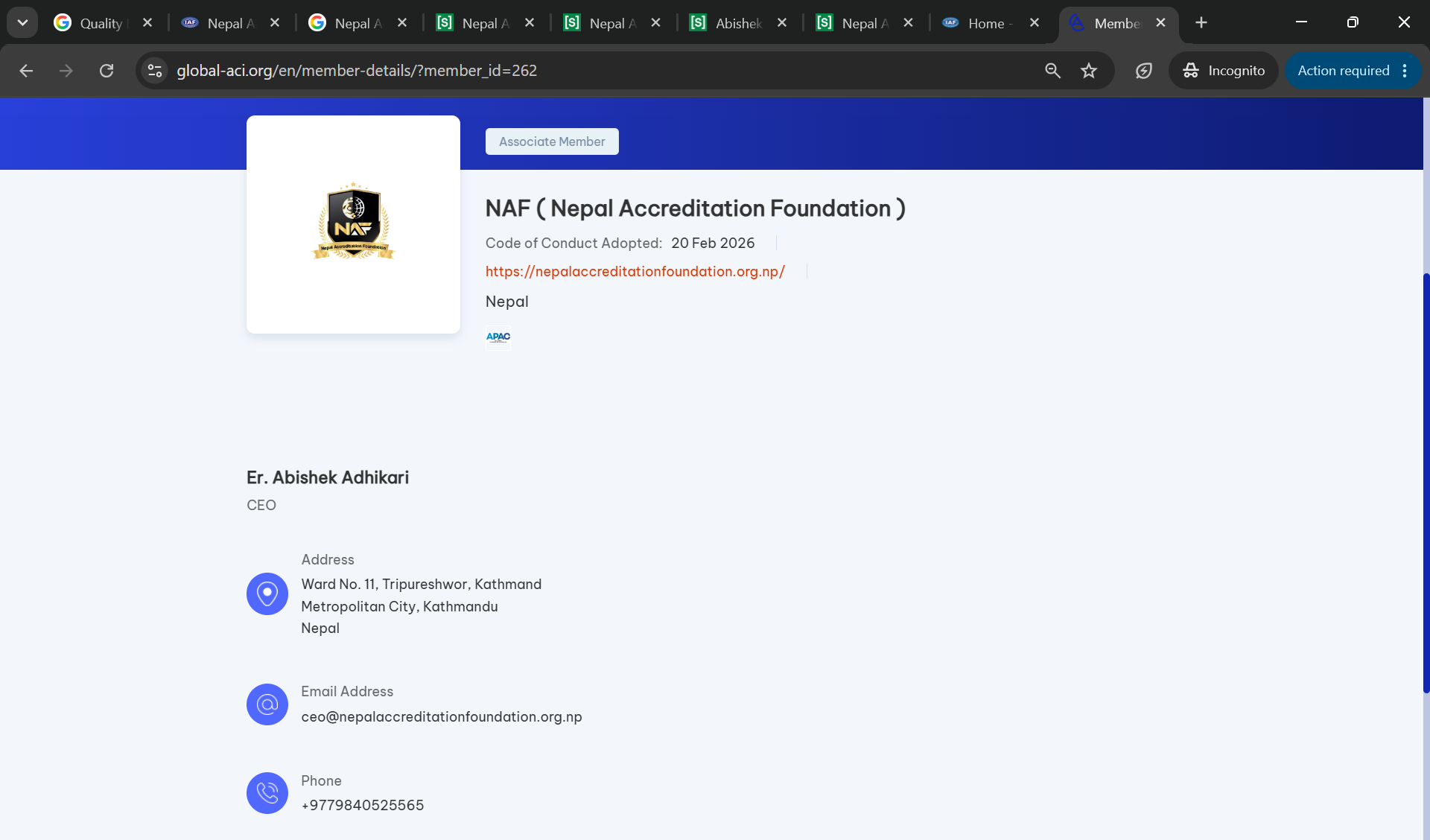
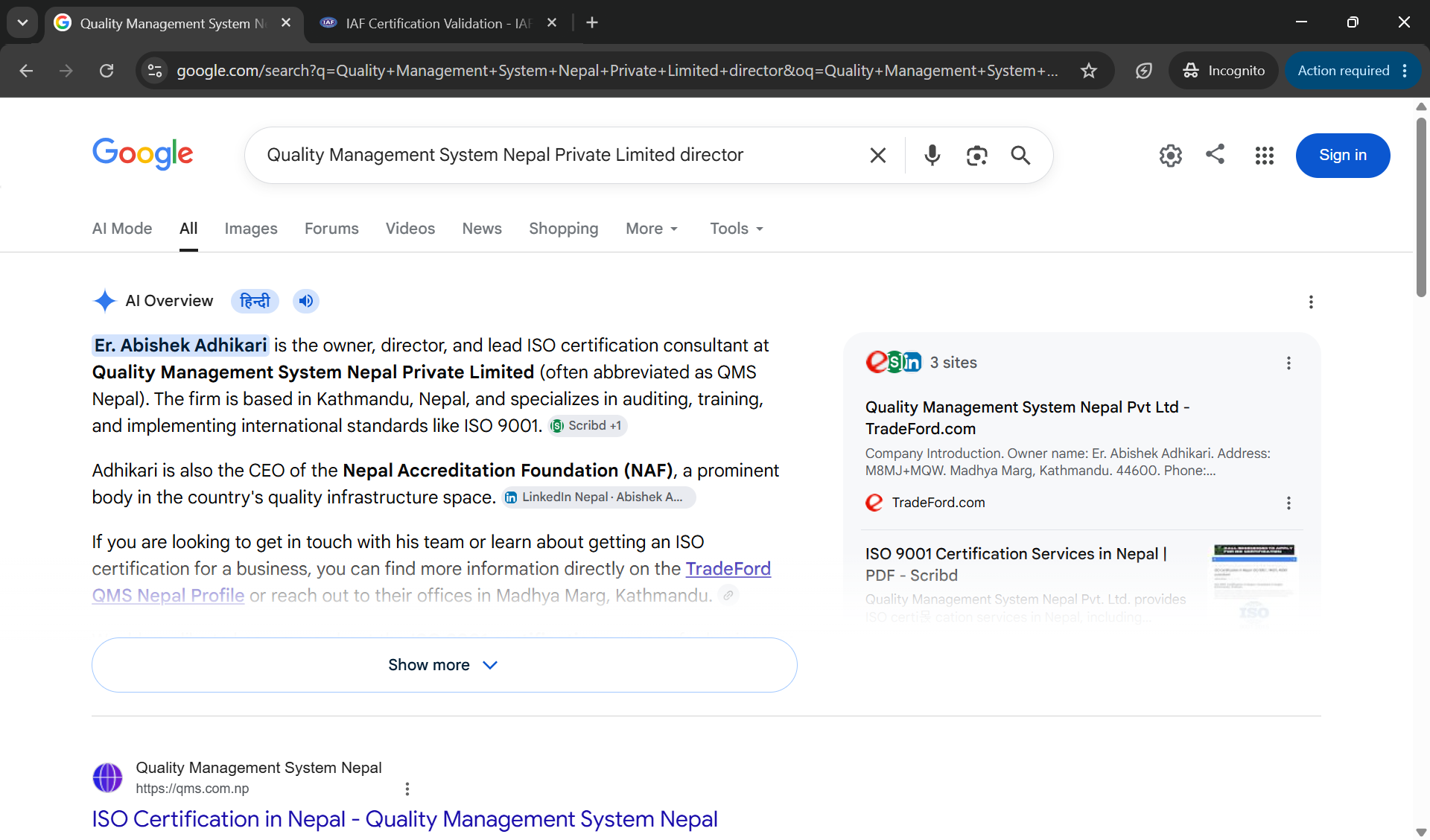
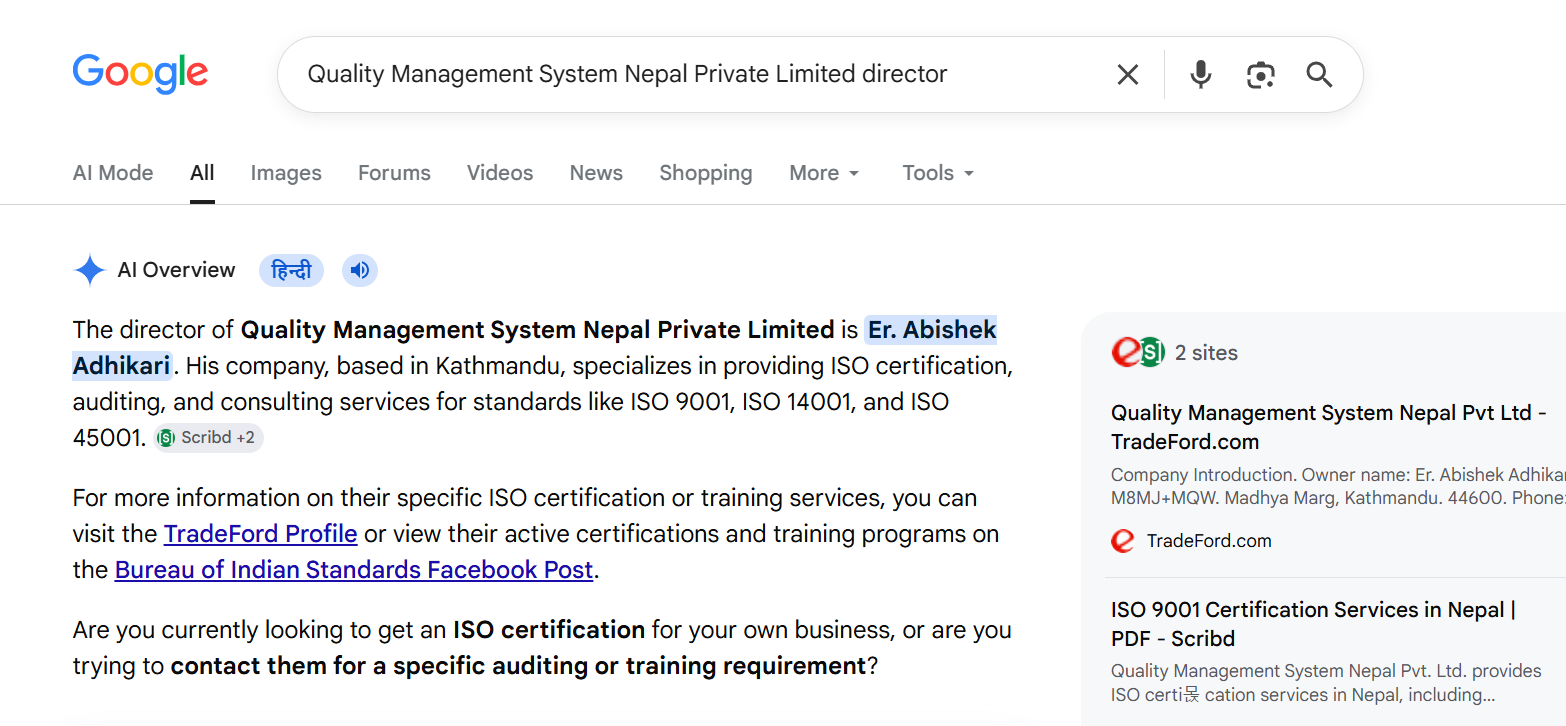
NAF’s CEO and Secretariat is listed as Er. Abishek Adhikari. Separately, Adhikari is identified as the director of Quality Management System Nepal Private Limited (QMS Nepal), a Kathmandu-based certification body offering ISO-related certification, auditing and consulting services.

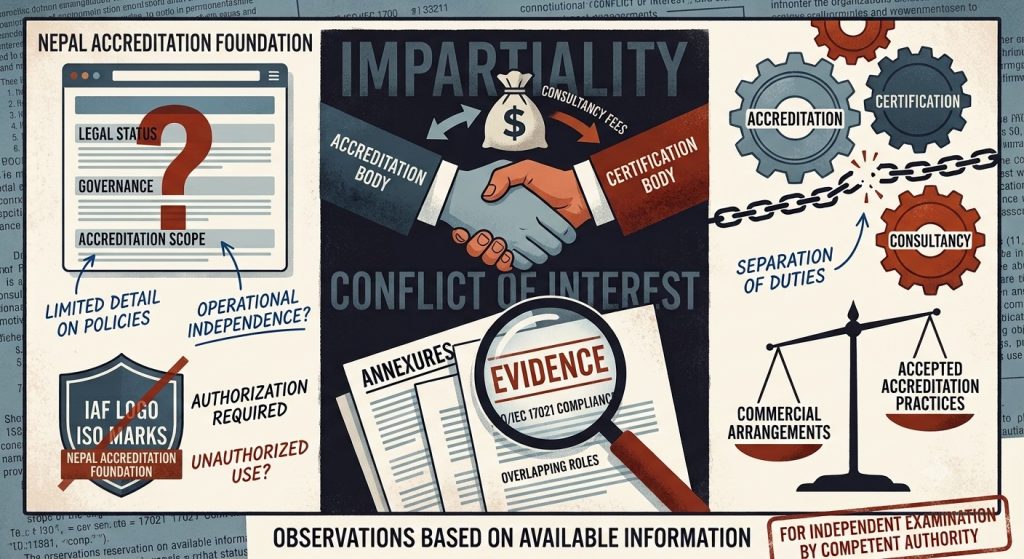
The relationship is significant because an Accreditation Body (AB) is expected to independently evaluate Certification Bodies (CBs). Where leadership overlaps between an accreditor and a certification body, questions concerning independence and impartiality naturally arise and should be examined against the applicable requirements.

The Membership Claim: A Timeline

NAF’s international recognition claims should be understood in the context of the transition from the International Accreditation Forum (IAF) to Global Accreditation Cooperation Incorporated (Global ACI).

18 Dec 2025
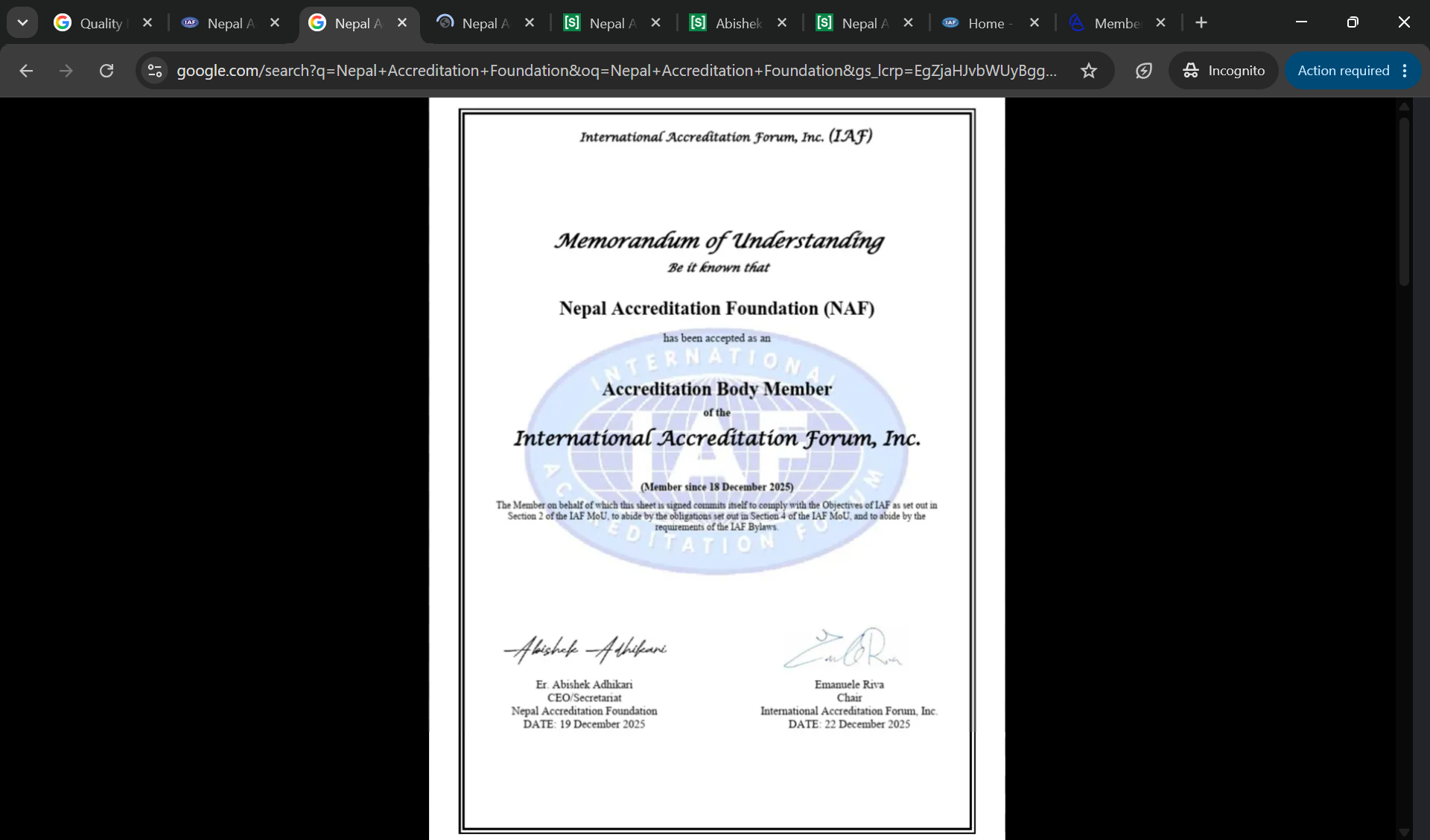
Er. Abishek Adhikari signed a memorandum of understanding on behalf of NAF relating to IAF membership.
1 Jan 2026
The IAF ceased operations and was succeeded by Global Accreditation Cooperation Incorporated (Global ACI).
July 2026
The membership information referenced in this review lists NAF as an Associate Member, rather than a Full Member or MLA signatory.

The distinction between membership and MLA signatory status is important. Businesses should not assume that an association or membership status automatically means that certificates issued through that accreditation chain carry international recognition.

IAF / Global ACI References and Branding

The material reviewed for this article raises questions about continued references to IAF, IAF MLA and IAF Mandatory Documents in NAF-related materials after the organizational transition.

The key issue for a certificate buyer is whether the representation on a website or application accurately describes the organization’s current membership and recognition status. Current status should be checked directly with the relevant international organization rather than inferred from historical references or logos.

Governance Transparency

A credible accreditation system depends not only on technical procedures but also on transparent governance and accessible mechanisms for complaints, appeals and impartiality safeguards.

The review identified questions around the public availability of the following information:

  • Legal identity: whether a clear legal registration and governing instrument are publicly disclosed.
  • Governance: whether board composition, decision-making and oversight arrangements are clearly published.
  • Complaints and appeals: whether an accessible formal process is available to affected parties.
  • Scope and accredited bodies: whether businesses can independently identify the organizations accredited by NAF.

The absence or difficulty of finding such information does not by itself establish wrongdoing. It does, however, make independent verification more difficult and is therefore relevant to businesses evaluating an accreditation claim.

QMS Nepal: Verify the Accreditation Chain

QMS Nepal publicly describes itself as an ISO certification body and states that it is accredited. The question for certificate users is not simply whether a company uses the word “accredited,” but which body granted that accreditation and whether that accreditor currently has the recognition required for the intended use of the certificate.

Verification question

If a certificate is issued by a Certification Body, ask for the exact name of the accreditor, the accreditation scope, the current recognition status and the relevant public registry entry. Verify each item independently.

The Pricing Question

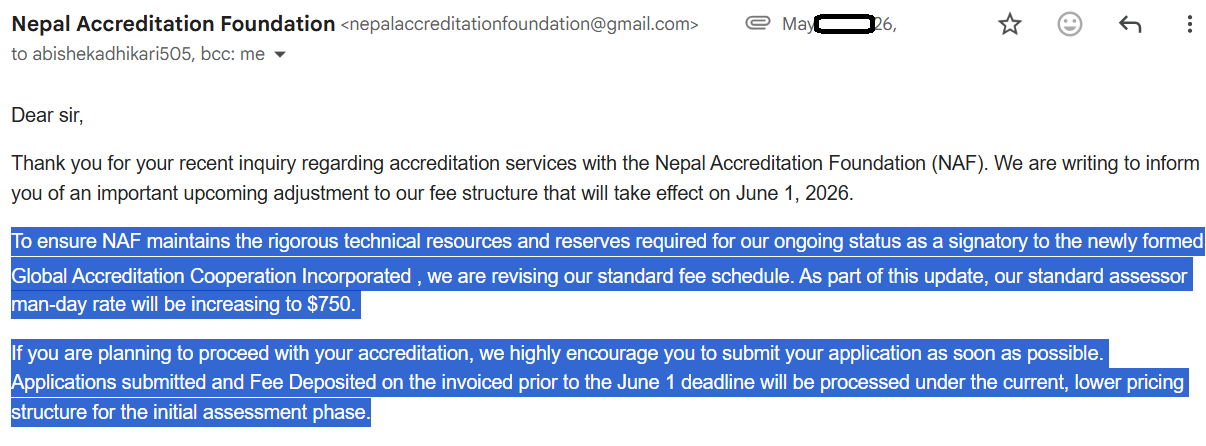
Correspondence reviewed and attributed to NAF includes communication concerning an adjustment to fees and an incentive to submit and pay before a stated cutoff date.

The material also uses wording concerning NAF’s status with the newly formed Global Accreditation Cooperation Incorporated. Because membership categories and recognition status are important to accreditation claims, such statements should be compared directly with the current official membership records.

Marketing Materials and ISO Logos

The review also raises questions about the use of official-looking ISO logos, certification badges and ISO-related imagery on websites and service pages.

ISO does not itself issue ISO certificates or endorse individual certification bodies. Businesses should therefore distinguish between an ISO standard, a Certification Body, an Accreditation Body and any membership or recognition mark displayed in marketing material.

A Wider Accreditation Context

The review also refers to earlier questions surrounding private accreditation organizations operating in Nepal, including AERSSC and its former ILAC MRA signatory status.

These examples should be treated as context rather than proof of any allegation concerning NAF. The relevant lesson for certificate users is that accreditation status can change and should be checked at the time a certificate is being relied upon.

At a Glance

Entity Type Recognition / Status Transparency point
NEPLAB Government national accreditation body National statutory framework Governed under published legislation
NAF Private accreditation organization Associate Member — verify current status Legal and governance disclosures should be independently verified
QMS Nepal Certification body Accreditor should be independently confirmed Verify the complete certification-to-accreditation chain
AERSSC Private accreditation organization Former ILAC MRA signatory; status changed in 2023 Illustrates why current status matters

Frequently Asked Questions

Is NAF a member of IAF?

The material reviewed states that NAF signed IAF membership documents on 18 December 2025. It also states that IAF ceased operations on 1 January 2026 and that Global ACI subsequently listed NAF as an Associate Member. Current status should be confirmed directly with Global ACI.

Does Associate Membership automatically mean MLA recognition?

No assumption should be made. Membership category and MLA signatory status are separate matters. Businesses should verify the current MLA status of the accreditor and whether the intended certificate falls within the recognized scope.

How should QMS Nepal accreditation be verified?

Ask QMS Nepal for the exact accrediting body, accreditation number, scope and current recognition details, then verify those details independently through the relevant official registry.

Who is identified as the head of NAF?

The public material reviewed identifies Er. Abishek Adhikari as CEO/Secretariat of NAF and separately identifies him as director of QMS Nepal. The relationship should be independently checked against current official records.

What is Nepal's government national accreditation body?

The material reviewed identifies NEPLAB, operating under NBSM, as Nepal's statutory national accreditation body. Readers should verify the current legal and institutional position through the relevant Nepal government sources.

What Businesses Should Verify

If you hold, or are considering accepting, an ISO certificate connected with NAF or QMS Nepal, the safest approach is to verify the entire chain rather than relying on a logo or marketing statement.

1
Check the certification body.
Confirm the legal name, certificate number and scope.
2
Check the accreditor.
Ask exactly which Accreditation Body accredited the Certification Body.
3
Check recognition.
Verify current MLA/signatory status and scope directly through the relevant international registry.
4
Check legal identity.
Request incorporation or governing documents where appropriate.
5
Check before payment.
Verify the accreditation chain before paying for certification where recognition is important to your tender, customer or regulator.

Source and verification note: This article is based on the supplied public-record review and the documentary material referenced in the annexures. It is not a legal finding. Readers and affected parties should verify disputed matters through Global ACI, IAF CertSearch where applicable, Nepal's Office of Company Registrar, and other competent authorities.

Documentary Annexures

The following evidence files are provided as separate references. Click any card to open the full-size document image.
Nepal Accreditation Foundation: What the Public Record Actually Shows

A review of NAF’s international recognition claims, its relationship with QMS Nepal, and what businesses relying on ISO certificates in Nepal should verify before trusting the paperwork.

Nepal has exactly one government-mandated national accreditation body: NEPLAB, operating under the Nepal Bureau of Standards and Metrology (NBSM), Ministry of Industry, governed by the Nepal Standards (Certification Mark) Act. Alongside it has emerged a private organization, the Nepal Accreditation Foundation (NAF), which markets itself as an independent accreditation body with international standing.

That claim does not hold up to scrutiny — and the gap between what NAF says about itself and what the public record shows is significant enough that any business holding, or considering, a certificate accredited by NAF should stop and verify before relying on it.

This piece lays out what is documented, what is unclear, and what remains unproven. It does not allege criminal conduct — that determination requires a regulator, auditor, or court. It documents discrepancies and transparency gaps and leaves readers to draw their own conclusions.

Who Is Behind NAF?

NAF’s CEO and Secretariat is listed as Er. Abishek Adhikari. Public records and NAF’s own membership documents identify him in that role. Separately, Adhikari is also the director of Quality Management System Nepal Private Limited (QMS Nepal), a Kathmandu-based certification body offering ISO 9001, 14001, 45001, 22000, and 27001 certification, auditing, and consulting services.

The overlap matters because of how accreditation is supposed to work. An Accreditation Body (AB) — NAF’s claimed role — is meant to sit above and independently evaluate Certification Bodies (CBs) like QMS Nepal, which in turn certify individual businesses. When the same person sits at the top of both the accreditor and one of the bodies it accredits, the independence that the entire system depends on is compromised. ISO/IEC 17011, the international standard governing accreditation bodies, exists specifically to prevent this kind of overlap.

The Membership Claim That Doesn't Add Up

NAF’s central credibility claim is membership in the International Accreditation Forum (IAF), historically the global body whose Multilateral Recognition Arrangement (MLA) is what makes an ISO certificate internationally meaningful — the difference between a certificate that means something across borders and one that doesn’t.

Here is the documented timeline:

  • 18 December 2025 — Er. Abishek Adhikari signs a Memorandum of Understanding on behalf of NAF, accepting it as an Accreditation Body Member of the IAF.
  • 1 January 2026 — The IAF ceases operations and is succeeded by Global Accreditation Cooperation Incorporated (Global ACI).
  • July 2026 — Global ACI’s own membership resolutions list NAF as an Associate Member only — not a Full Member, and critically, not an MLA signatory.

In plain terms: NAF’s foundational membership claim rests on a body that dissolved roughly two weeks after signing it. And the successor organization’s own records show NAF holds a membership tier that carries no MLA recognition at all. Associate Membership does not confer the multilateral recognition that gives an accreditation mark its international meaning — the exact thing NAF’s marketing implies it has.

Despite this, NAF’s website and application materials continue to reference the IAF, the IAF MLA, and IAF Mandatory Documents, and its application form reportedly commits applicants’ data to a “Global Accreditation Cooperation Database.” Continuing to invoke IAF/Global ACI branding at Associate Member level risks creating a false impression of recognition NAF does not currently hold.

Zero Governance Transparency

Accreditation bodies are expected — under ISO/IEC 17011 — to publish certain baseline information: governing legal status, board composition, an impartiality and conflict-of-interest policy, an accessible complaints and appeals process, and a published scope of accreditation.

A review of NAF’s public materials found none of these disclosed:

  • No verifiable legal identity. NAF’s website does not disclose whether it is registered as a private company, an NGO, or under any specific government mandate. There is no visible link to a Certificate of Incorporation from Nepal’s Office of Company Registrar.
  • No governance structure. No published board composition, no decision-making process, no oversight mechanism.
  • No complaints or appeals process. No visible channel through which a certified business, competitor, or member of the public could formally challenge an accreditation decision.
  • No published scope or accredited-body list, making independent verification of who NAF has actually accredited difficult.

For an organization asking businesses and certification bodies to trust its judgment — and to pay for that judgment — the absence of the most basic self-disclosure is itself notable.

QMS Nepal: Certification Without a Clearly Named Accreditor

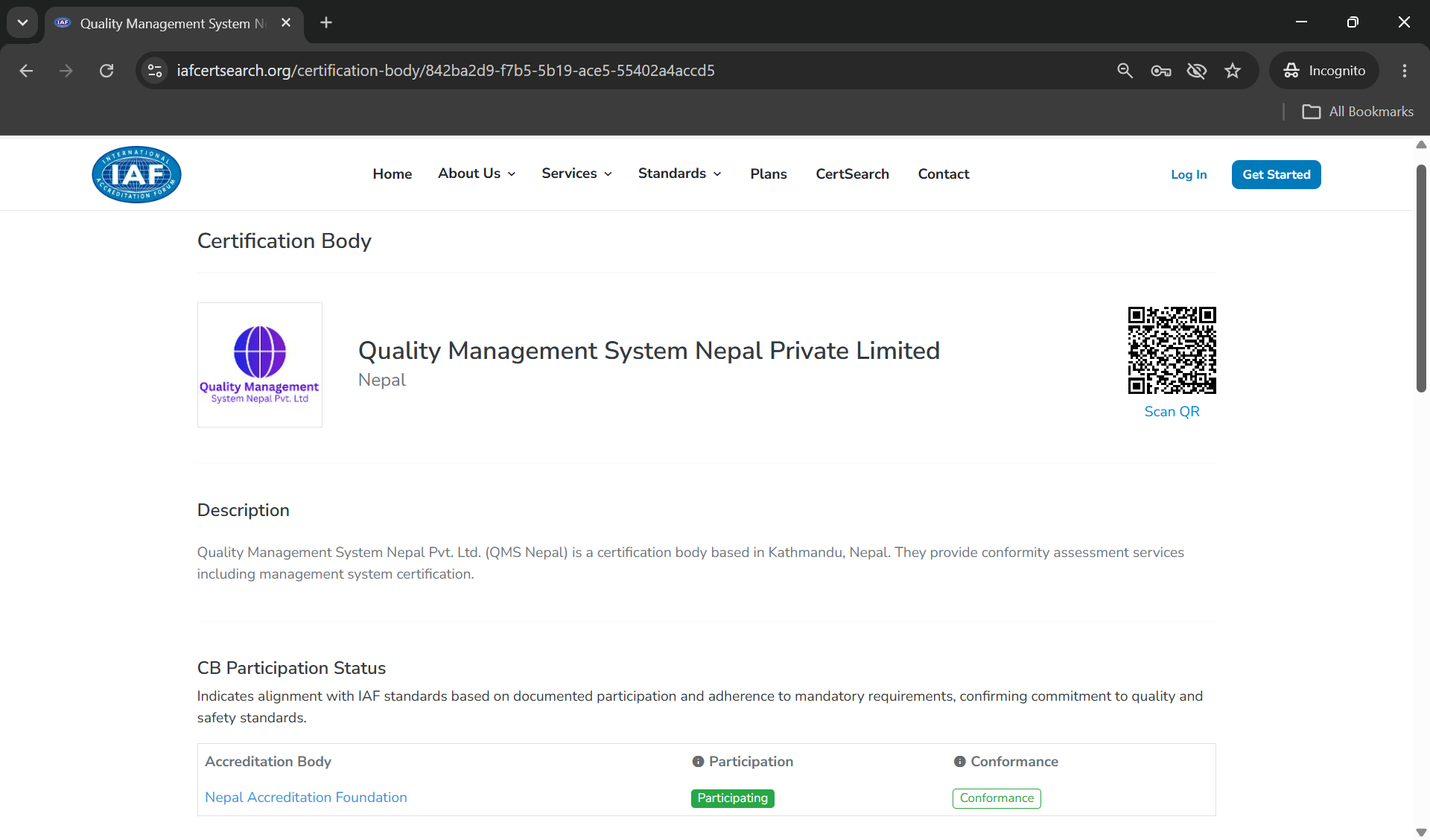
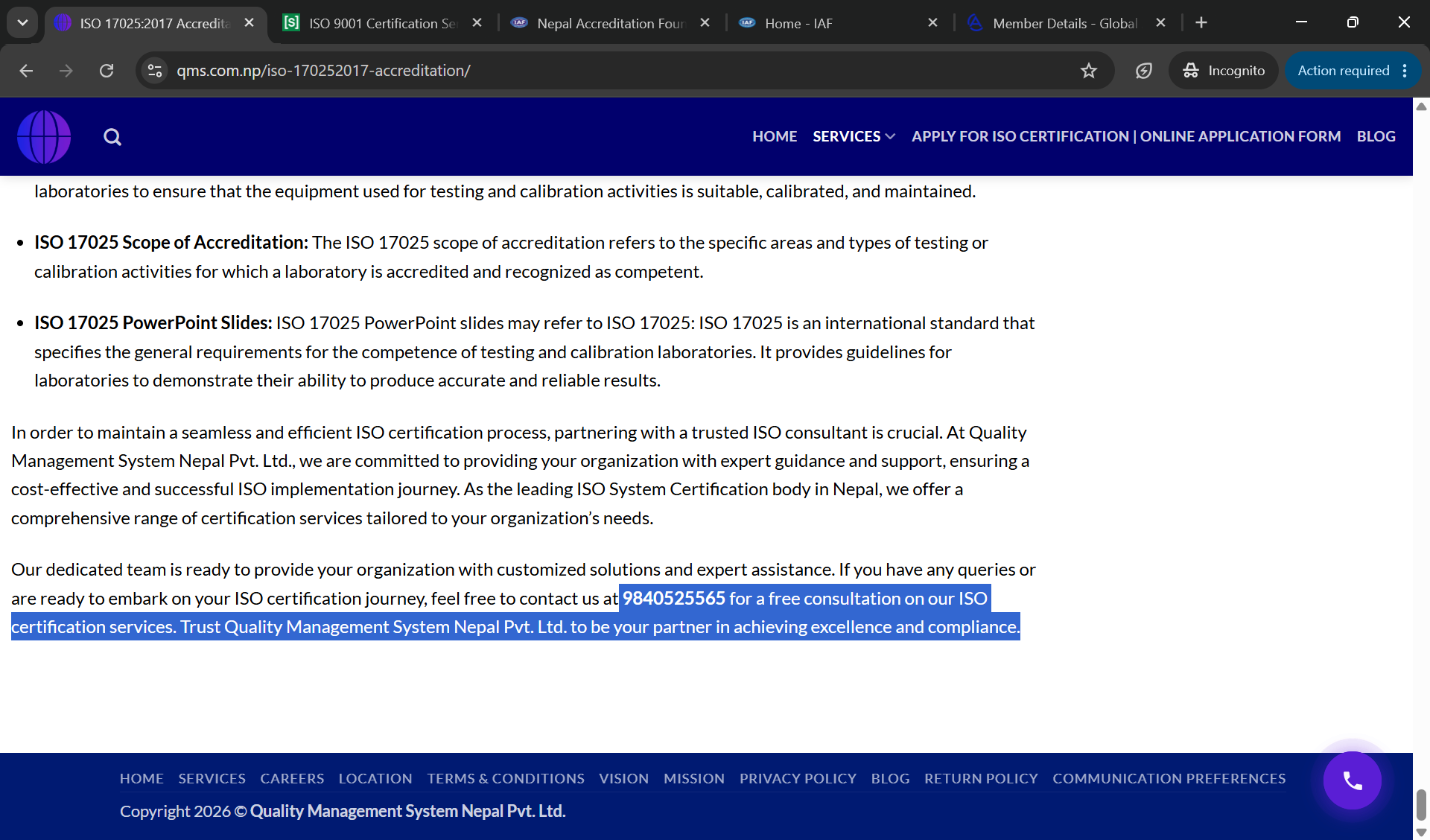
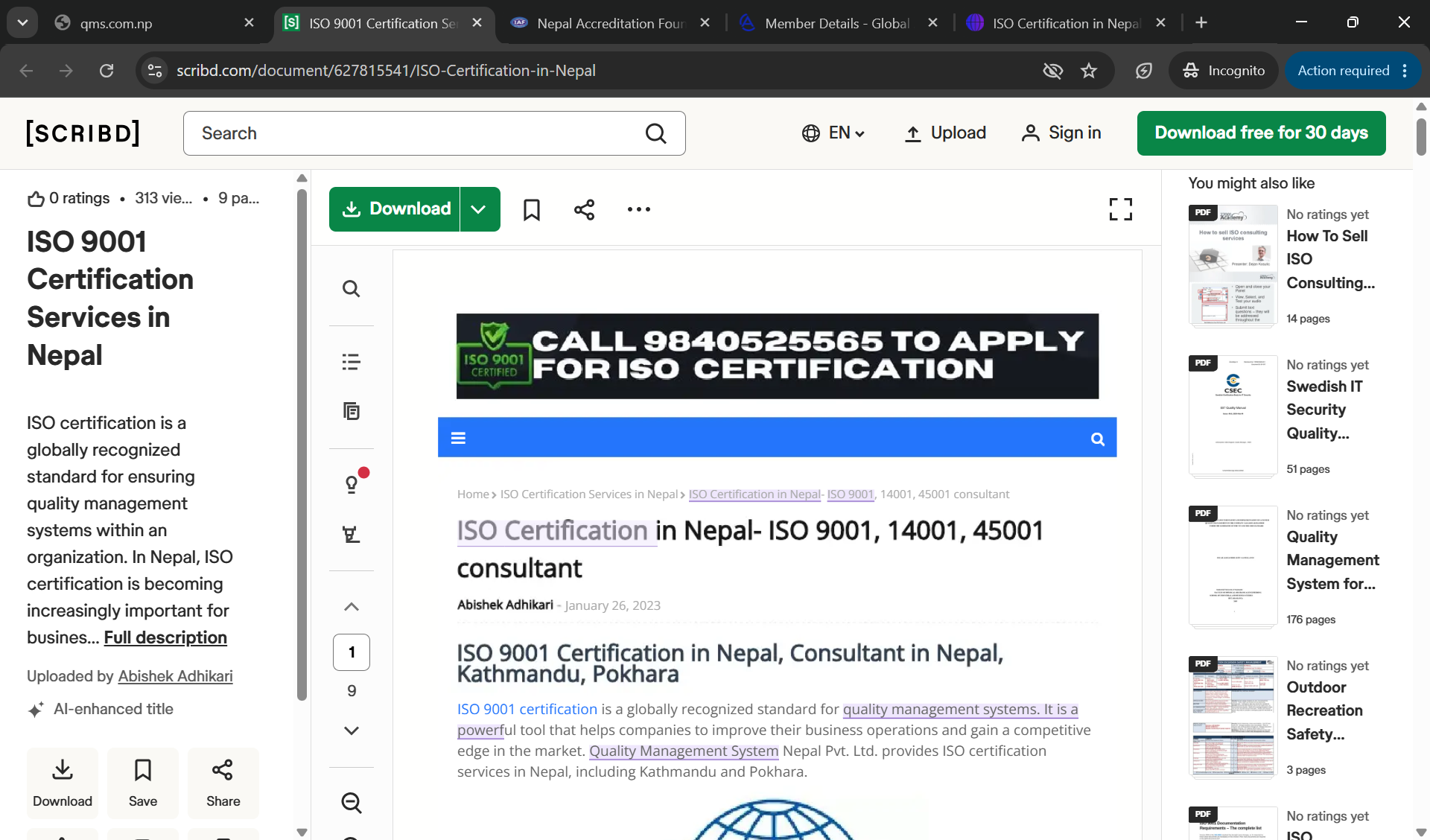
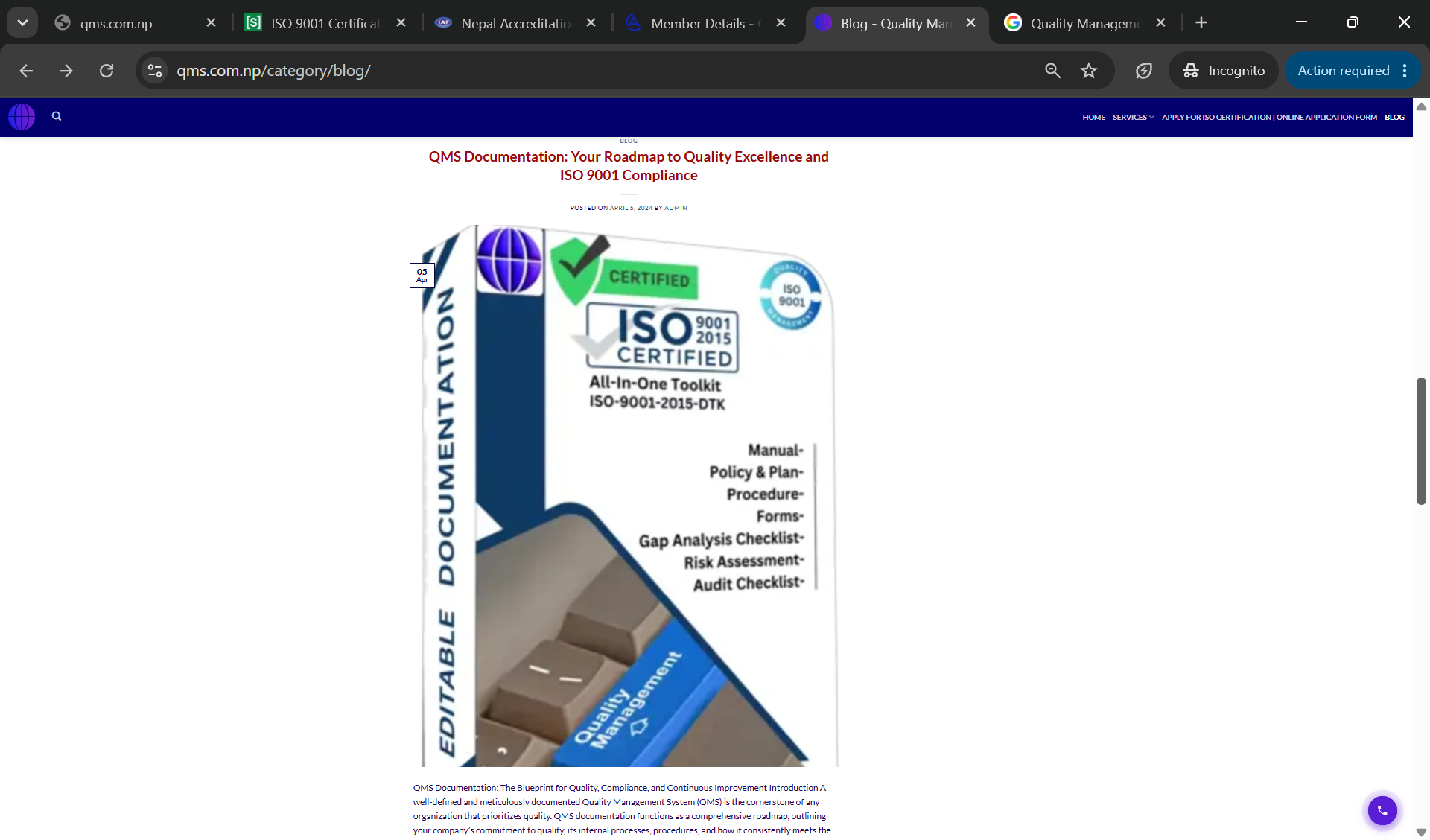
QMS Nepal’s own marketing describes it as “the leading ISO System Certification body in Nepal” and states it is accredited, without clearly naming the accrediting body on its public-facing pages. It is not listed in IAF CertSearch — the official global database — as accredited under any recognized Global ACI/MLA signatory.

If QMS Nepal’s accreditation traces back to NAF, its certificates inherit every limitation described above: no MLA recognition, no verified governance, no independently confirmed legal standing. That would mean businesses that paid for and hold a QMS Nepal ISO certificate may be holding a document with far less international standing than the certificate itself implies.

The Pricing Question

Correspondence reviewed and attributed to NAF (sent to a certification body applicant) informs the recipient of an “important upcoming adjustment” to NAF’s fee structure, citing the need to “maintain the rigorous technical resources and reserves required for our ongoing status as a signatory to the newly formed Global Accreditation Cooperation Incorporated.” The email raises the standard assessor day-rate and explicitly encourages the applicant to submit and pay before a cutoff date to lock in the lower rate.

Two things stand out. First, the email describes NAF’s Global ACI status as a “signatory” — language stronger than the Associate Member (non-MLA-signatory) status Global ACI’s own July 2026 resolutions actually record. Second, urgency-driven fee communications sent to applicants whose accreditor’s own legal status and governance are undocumented is a pattern worth applicants scrutinizing closely before paying.

Marketing Materials and ISO Logos

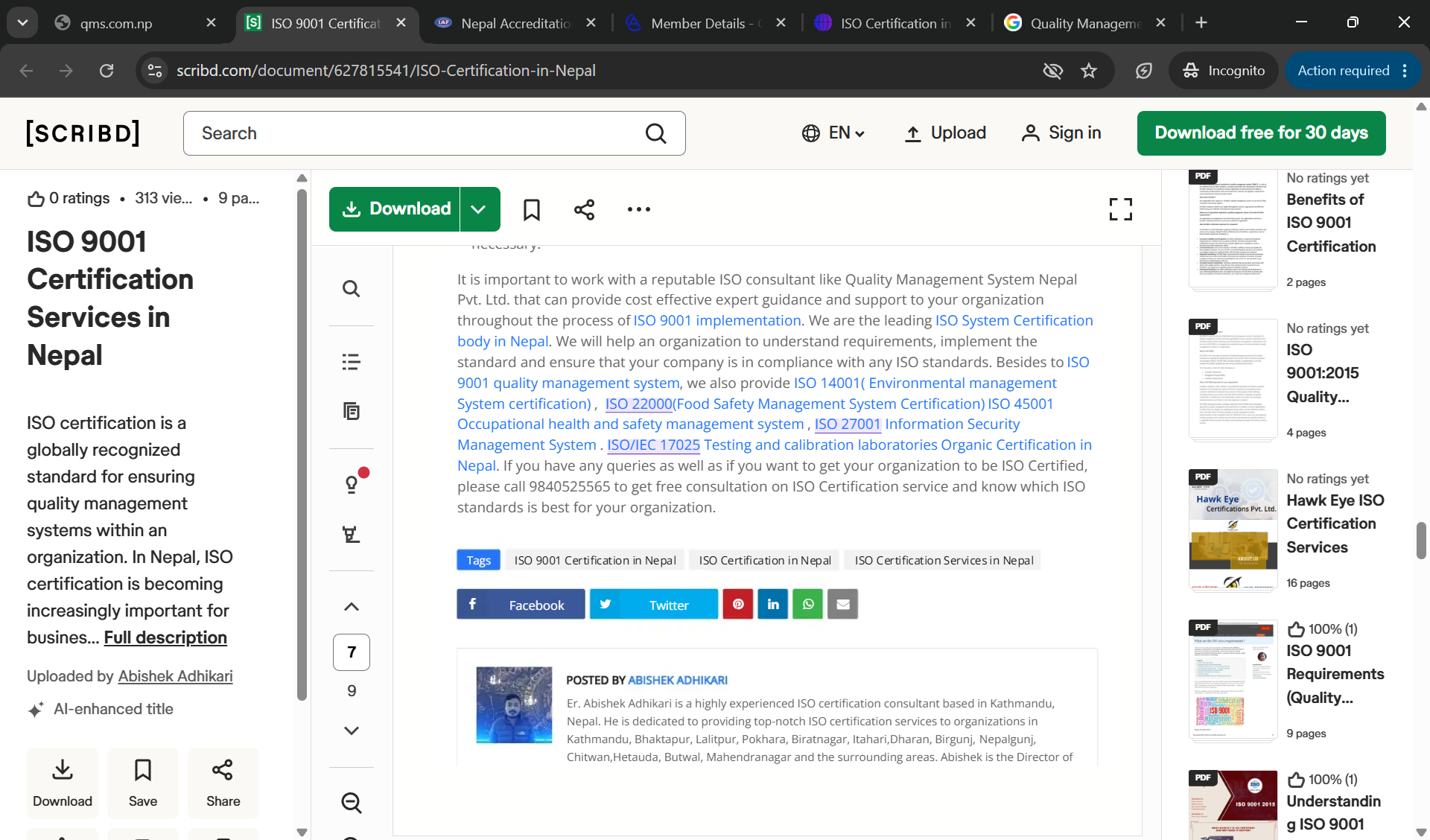
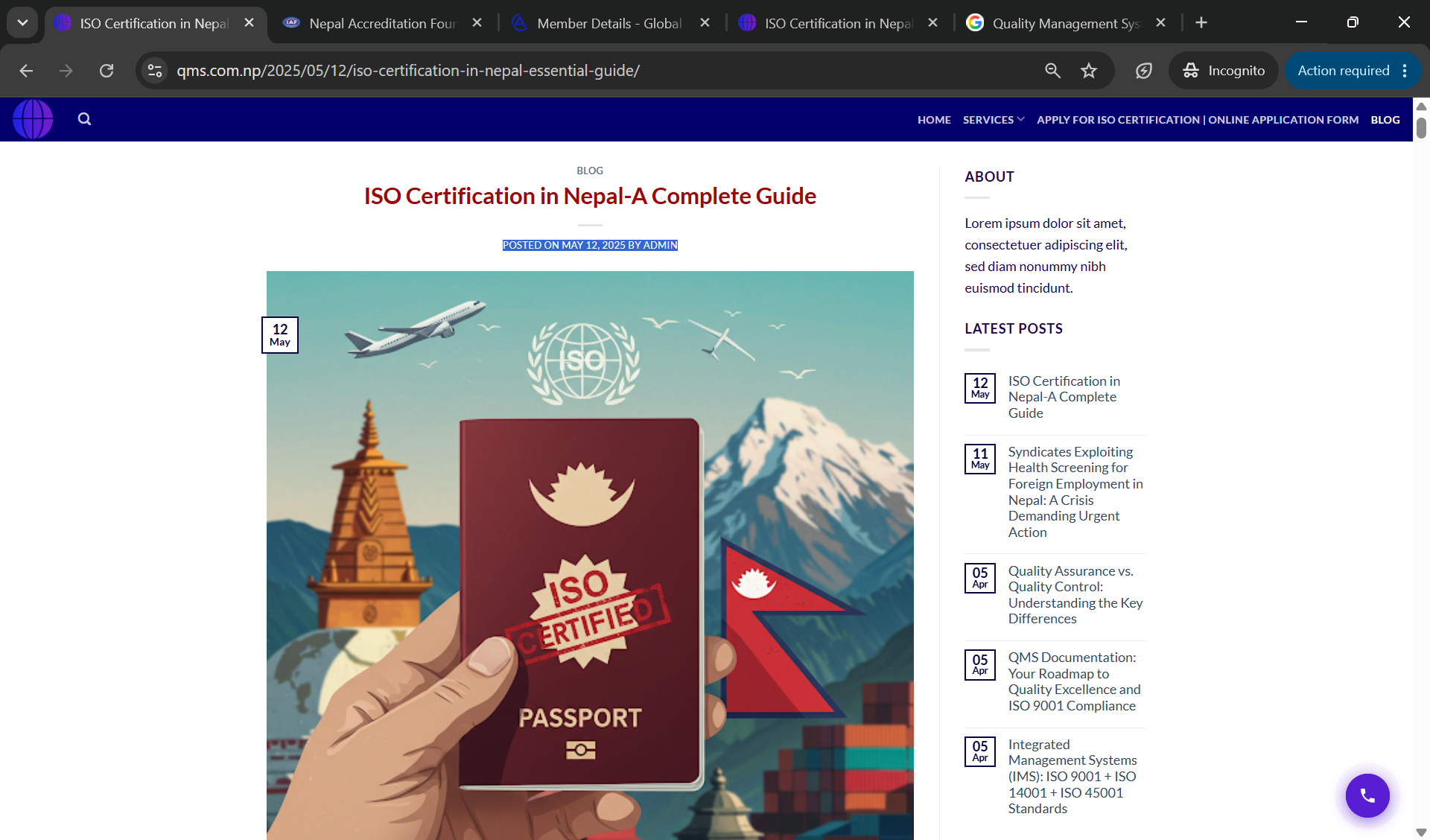
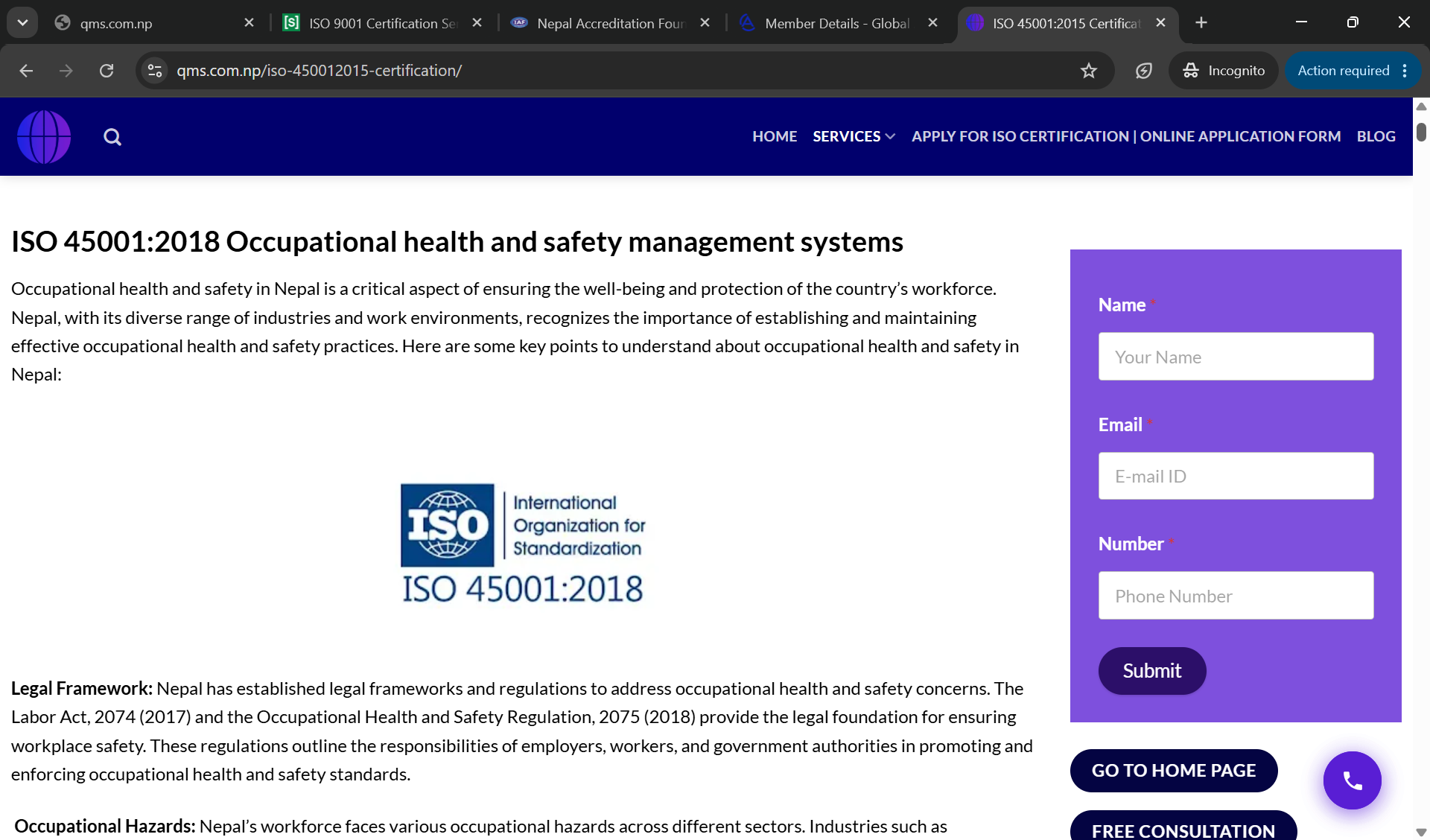
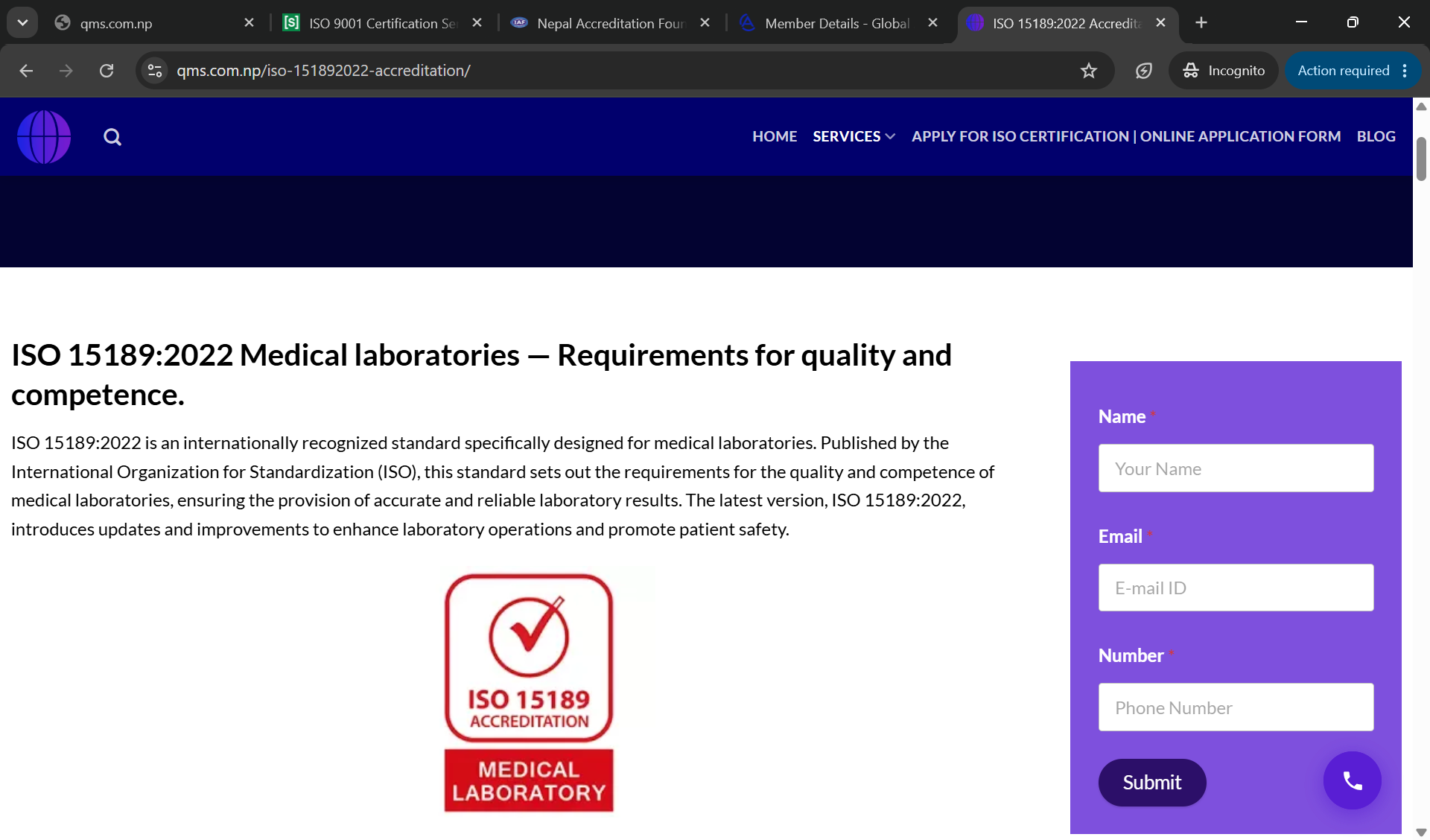
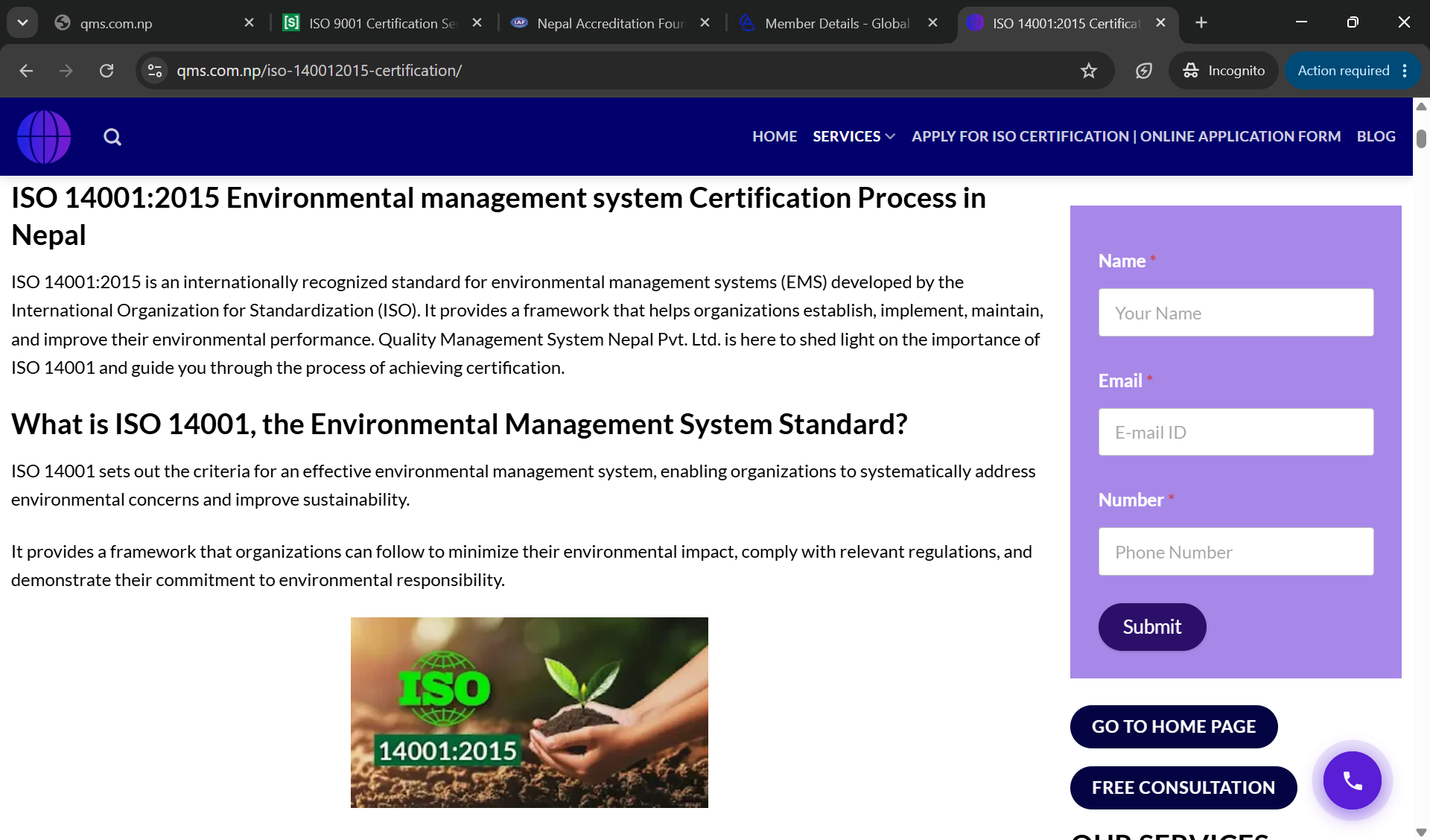
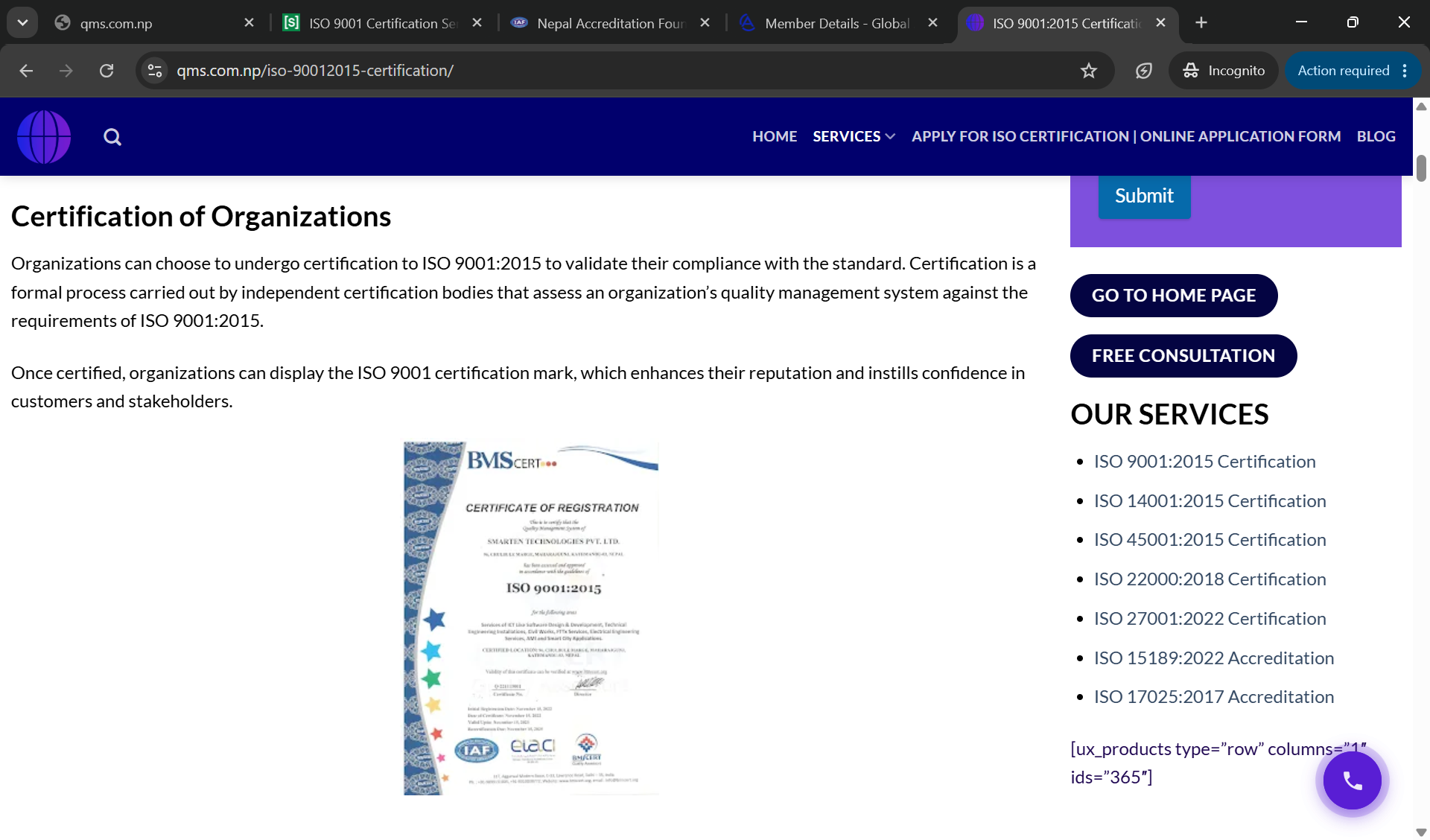
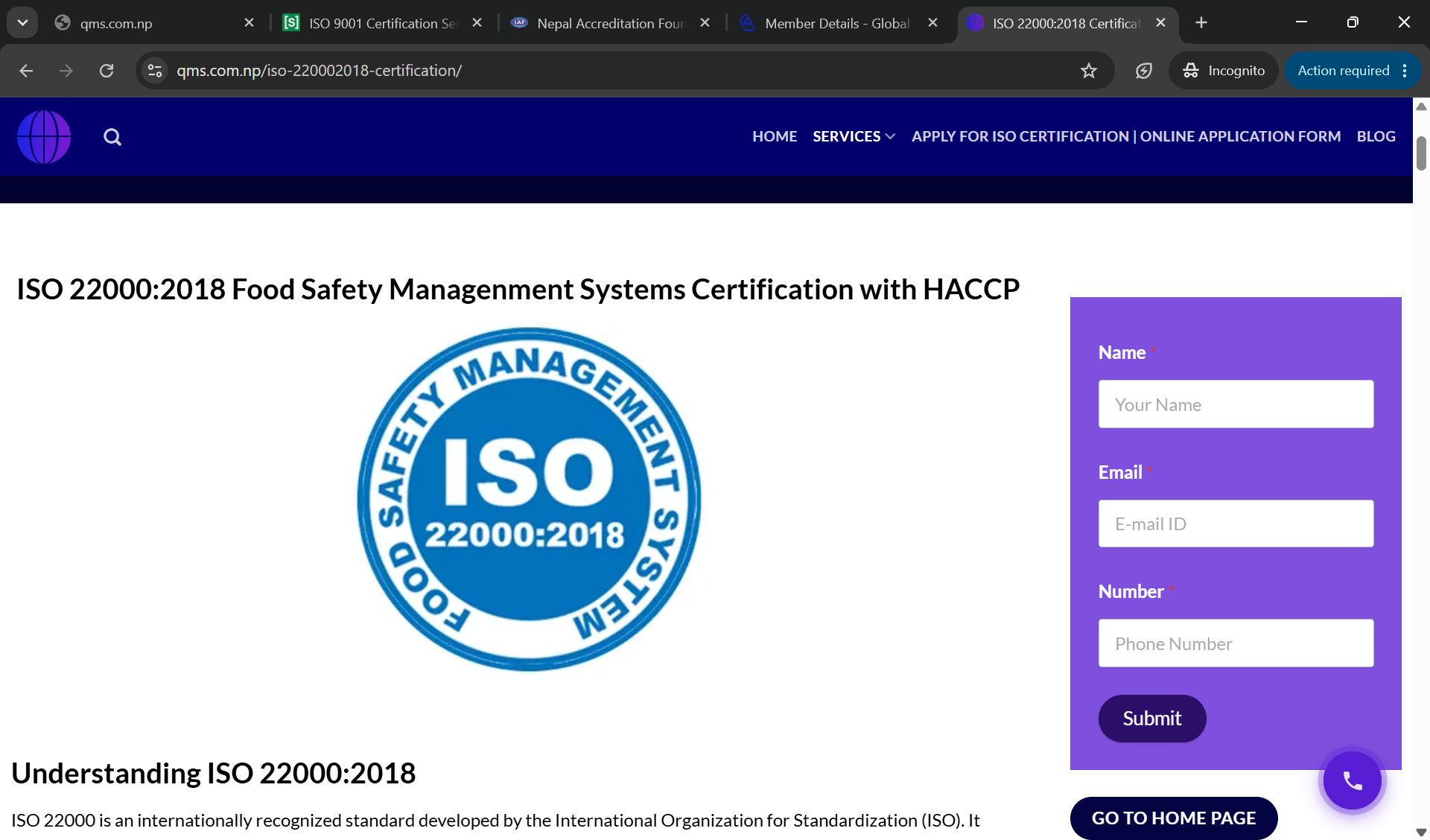
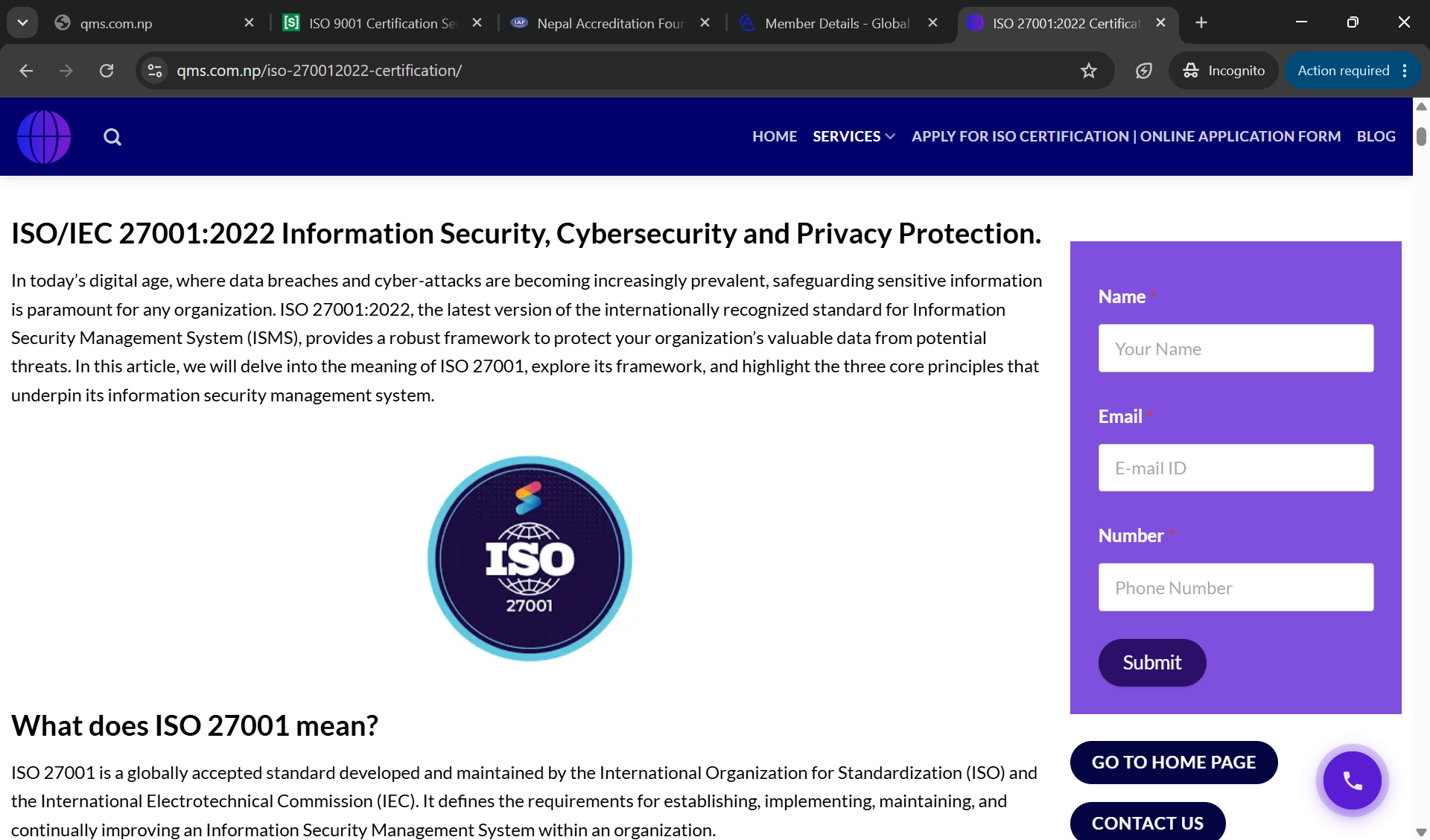
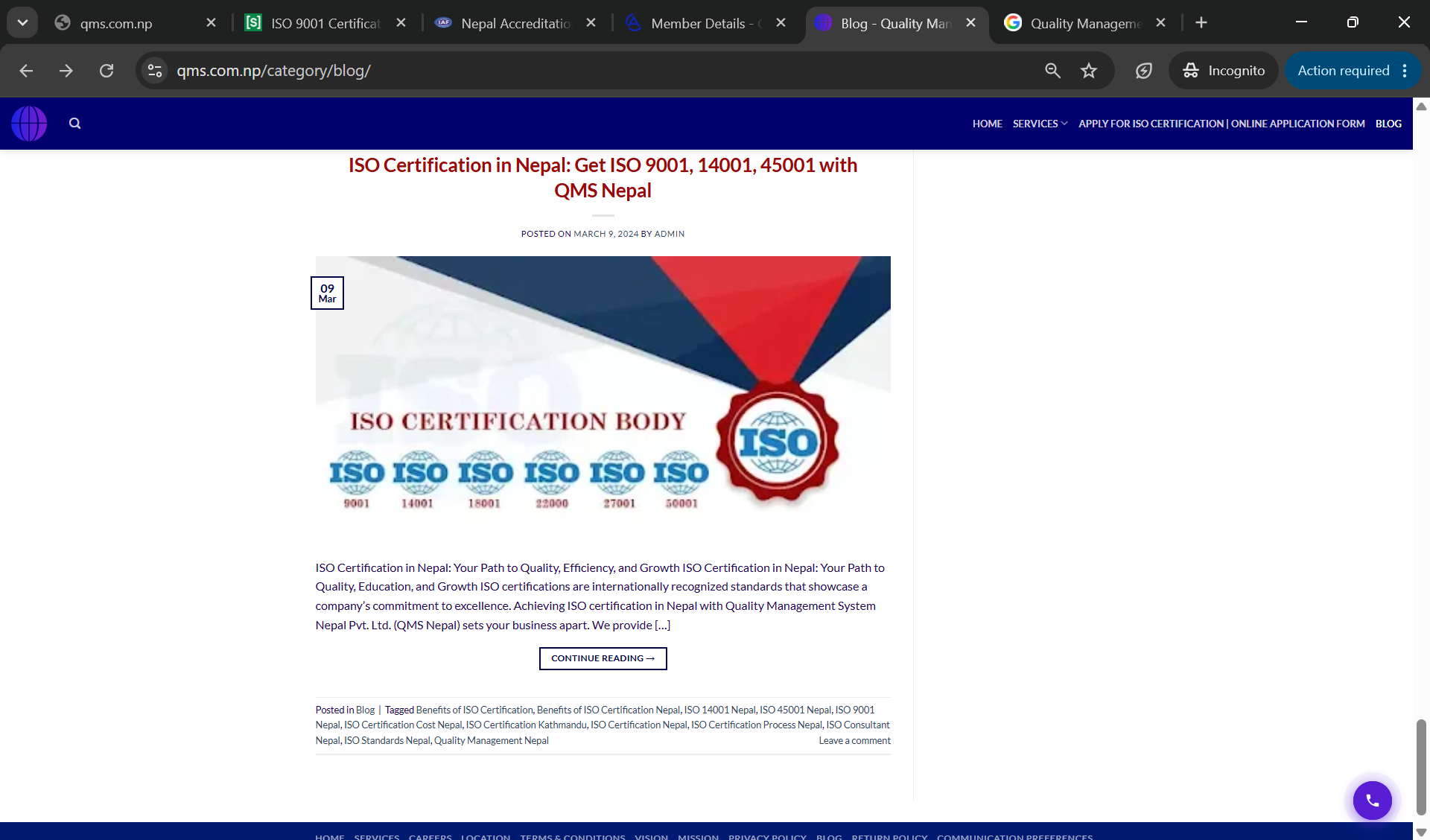
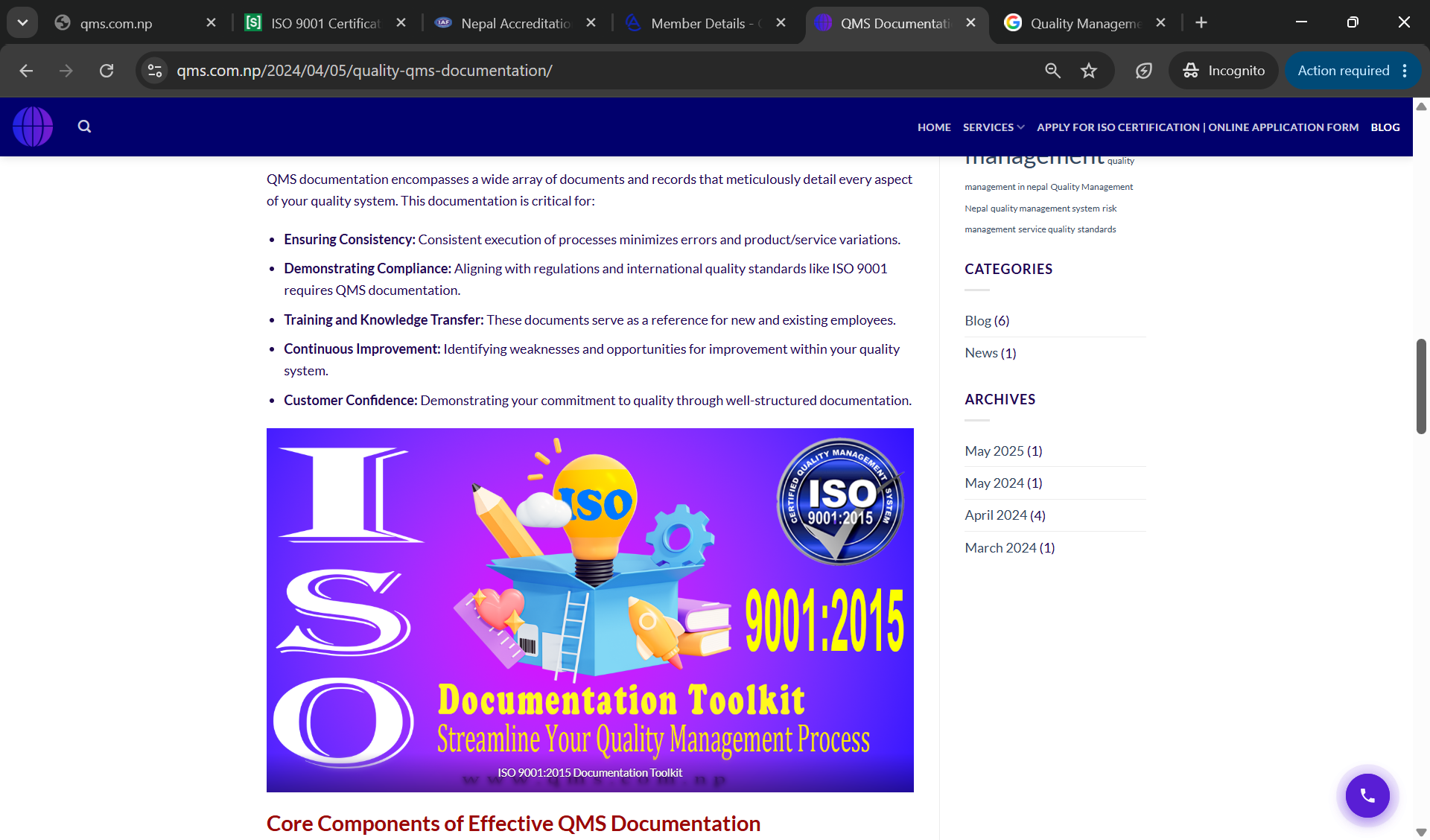
QMS Nepal’s website and blog content make broad use of official-looking ISO logos and certification badge imagery across service pages (ISO 9001, 14001, 17025, 22000, 27001, 45001, 15189, and others), alongside lead-capture forms collecting name, email, and phone number. The International Organization for Standardization (ISO) does not itself issue certificates or endorse specific certification bodies, and its logos and marks are subject to usage restrictions. The prominent, repeated display of these marks alongside direct sales calls-to-action is a pattern regulators and industry watchdogs typically flag for review.

Not Nepal's First Case

This is not the first time a private Nepali accreditation body’s international standing has come into question. AERSSC, another private accreditation body operating in Nepal, previously held ILAC MRA signatory status — and had it discontinued in early 2023, reportedly for insufficient evidence of self-support and a limited number of accredited laboratories.

Industry watchdog Oxebridge has separately documented broader concerns about vetting standards during the IAF-to-Global ACI transition, including prior cases of accreditation bodies with questionable compliance records being accepted into IAF/APAC membership — citing the United Accreditation Foundation (UAF) as one such precedent, alleged to have operated as a “certificate mill” while holding IAF membership. Oxebridge has also reported that NAF was accepted into IAF with Oxebridge’s assistance, and noted NAF’s own stated intention to exceed IAF/GACI requirements — phrasing that implicitly acknowledges the baseline bar was not self-evidently met.

At a Glance

Entity

Type

International Status

Legal Transparency

NEPLAB (NAB)

Government national accreditation body

Not an IAF/Global ACI member; NBSM is a member of ISO and IEC directly

Full — governed by published Act

NAF

Private accreditation body

Associate Member of Global ACI only — not MLA signatory

None disclosed — legal form unclear

QMS Nepal

Certification body

Accreditor not clearly named; not listed in IAF CertSearch

Minimal — private company, no accreditor confirmed

AERSSC

Private accreditation body

Former ILAC MRA signatory; status discontinued 2023

Minimal — private company

Frequently Asked Questions

Is Nepal Accreditation Foundation (NAF) a member of IAF? NAF signed IAF membership documents on 18 December 2025. The IAF itself ceased operations on 1 January 2026 and was replaced by Global Accreditation Cooperation Incorporated (Global ACI). As of Global ACI’s July 2026 resolutions, NAF holds Associate Member status only — not Full Member, and not MLA signatory status.

What is the difference between Associate Member and MLA signatory status? MLA (Multilateral Recognition Arrangement) signatory status is what gives an accreditation mark international recognition. Associate Membership does not confer MLA signatory status, meaning certificates issued under an Associate Member’s accreditation are not automatically recognized internationally.

Is QMS Nepal accredited? QMS Nepal publicly states it is accredited but does not clearly name its accrediting body on its public pages, and it does not appear in IAF CertSearch as accredited under a recognized MLA signatory.

Who runs Nepal Accreditation Foundation? Er. Abishek Adhikari is listed as CEO/Secretariat of Nepal Accreditation Foundation. He is also the director of Quality Management System Nepal Private Limited (QMS Nepal), a certification body operating in the same market NAF accredits.

What is Nepal’s official government accreditation body? NEPLAB (Nepal Accreditation Board) is Nepal’s statutory national accreditation body, operating under the Nepal Bureau of Standards and Metrology (NBSM), Ministry of Industry, governed by the Nepal Standards (Certification Mark) Act.

What This Means If You Hold, or Are Considering, a Certificate

None of the individual points above proves wrongdoing on its own. Taken together, though, they describe a pattern that verification-minded businesses should not ignore: an international recognition claim that is technically outdated, a legal and governance structure that isn’t disclosed, a certification body under common leadership with its own accreditor, and a fee structure collected before any of the above can be independently confirmed.

Before accepting or relying on a NAF- or QMS Nepal-issued ISO certificate, businesses should:

  1. Search IAF CertSearch directly to check whether the certification body and its accreditor appear as recognized under a current MLA signatory.
  2. Contact Global ACI directly to confirm NAF’s current membership category and whether any MLA signatory status has since been granted.
  3. Request NAF’s Certificate of Incorporation and governing statute from Nepal’s Office of Company Registrar.
  4. Ask directly, in writing, who accredited the certification body you’re working with, and verify that accreditor’s status independently — don’t rely on the certificate or the website alone.

International accreditation exists to answer one question for the businesses and customers relying on a certificate: can this claim be trusted without having to check for yourself? On the evidence currently public, NAF’s claims outpace what its own documented status supports. Verify — don’t assume.

This article is based on publicly available information, including membership documents, correspondence, and organizational websites cited throughout. It does not constitute a legal finding. Readers and affected parties are encouraged to pursue independent verification through Global ACI, IAF CertSearch, and Nepal’s Office of Company Registrar.

Scroll to Top