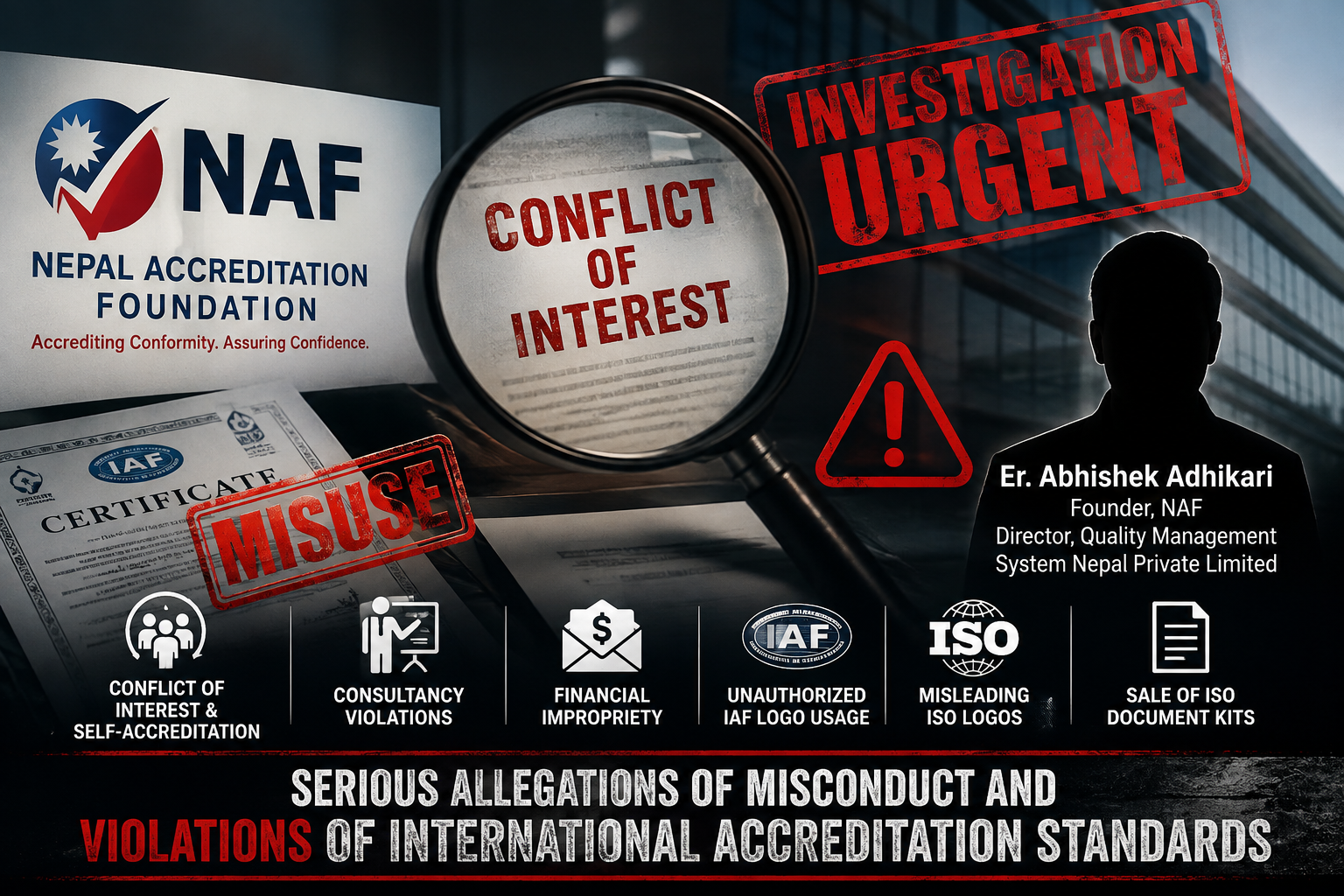
An examination of NAF’s claims to international recognition, its ties to QMS Nepal, how transparent its governance is, and what companies relying on ISO certificates in Nepal need to check before taking the documentation at face value.
Nepal Accreditation Foundation (NAF) | ISO Accreditation | Recognition & Membership | Independent Verification
Editorial note: This piece separates documented facts, questions those facts raise, and points that remain unverified. It makes no criminal allegation. Readers should confirm any disputed points on their own with the appropriate authorities and original records.
What the Records Reveal
Nepal’s official national accreditation body is NEPLAB, which functions under the Nepal Bureau of Standards and Metrology (NBSM) within the Ministry of Industry, pursuant to the Nepal Standards (Certification Mark) Act. Operating alongside this official structure, the Nepal Accreditation Foundation (NAF) markets itself as a separate, independent accreditation body.
What matters most isn’t simply the name an organization adopts. For companies depending on an ISO certificate, the real questions are: who is doing the accrediting, what is their recognition status right now, how much governance information is publicly accessible, and can the whole certification chain be traced and verified independently?
Why this matters: Accreditation exists to build confidence in a certification body’s competence and neutrality. Companies should therefore trace the accreditation chain themselves instead of taking logos, websites, or wording on a certificate at face value.
Who Runs NAF?
Er. Abishek Adhikari holds the roles of CEO and Secretariat at NAF. He is also named as director of Quality Management System Nepal Private Limited (QMS Nepal), a Kathmandu-based firm that provides ISO certification, auditing, and consulting services.
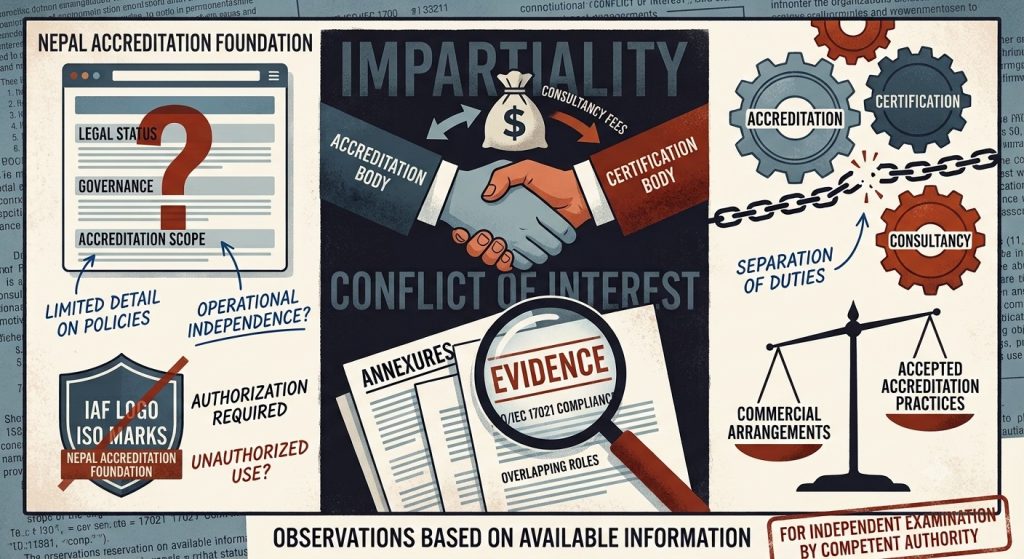
This overlap matters because an Accreditation Body (AB) is supposed to evaluate Certification Bodies (CBs) independently. When the same person leads both an accreditor and a certification body, it raises legitimate questions about independence and impartiality that deserve to be measured against applicable standards.
Tracking the Membership Claim
To understand NAF’s claims of international recognition, it helps to look at the shift from the International Accreditation Forum (IAF) to Global Accreditation Cooperation Incorporated (Global ACI).
- December 18, 2025 — Er. Abishek Adhikari signed a memorandum of understanding for NAF concerning IAF membership.
- January 1, 2026 — IAF wound down operations, replaced by Global Accreditation Cooperation Incorporated (Global ACI).
- July 2026 — Membership records reviewed for this piece show NAF listed as an Associate Member — not a Full Member and not an MLA signatory.
This distinction matters: membership status and MLA signatory status are not the same thing. Companies shouldn’t assume that belonging to an association automatically means certificates issued through that chain hold international recognition.
References to IAF/Global ACI and Branding
The materials examined here raise questions about NAF continuing to reference IAF, the IAF MLA, and IAF Mandatory Documents even after the organizational changeover.
For anyone buying a certificate, what matters is whether a website or application accurately reflects the organization’s actual, current membership and recognition status. That status is best confirmed directly with the relevant international body rather than assumed from old references or logos still in use.
How Transparent Is Its Governance?
A trustworthy accreditation system needs more than sound technical procedures — it also needs open governance and reachable channels for complaints, appeals, and impartiality protections.
This review found open questions about whether the following is publicly available:
- Legal identity — Is there a clearly disclosed legal registration and governing document?
- Governance — Are board makeup, decision-making, and oversight structures published clearly?
- Complaints and appeals — Is there an accessible, formal channel for affected parties?
- Scope and accredited bodies — Can businesses independently confirm which organizations NAF has accredited?
Not finding this information readily available doesn’t prove wrongdoing on its own. But it does make independent verification harder — which matters to any business assessing an accreditation claim.
QMS Nepal: Trace the Chain Yourself
QMS Nepal describes itself publicly as an accredited ISO certification body. The real question for anyone using such a certificate isn’t whether the word “accredited” appears — it’s which organization granted that accreditation, and whether that accreditor currently holds the recognition needed for your intended use of the certificate.
Verification tip: When a Certification Body issues you a certificate, ask for the accreditor’s exact name, the accreditation’s scope, its current recognition status, and where to find it in the relevant public registry. Confirm each detail yourself.
The Question of Pricing
Correspondence reviewed and attributed to NAF includes messaging about a fee change, along with an incentive to submit paperwork and pay before a given deadline.
That same correspondence uses language describing NAF’s standing with the newly established Global Accreditation Cooperation Incorporated. Because membership categories and recognition status are central to any accreditation claim, such statements deserve direct comparison against current official membership records.
Marketing Materials and ISO Logos
This review also flags questions about the use of ISO-style logos, certification badges, and ISO-related imagery across websites and service pages.
It’s worth remembering that ISO itself doesn’t issue certificates or endorse specific certification bodies. Businesses should keep clear the difference between an ISO standard, a Certification Body, an Accreditation Body, and any membership or recognition mark shown in promotional material.
The Broader Accreditation Landscape
This review also touches on earlier concerns involving other private accreditation bodies in Nepal, including AERSSC and its former status as an ILAC MRA signatory.
These examples are offered as context, not as evidence supporting any claim about NAF specifically. The takeaway for anyone relying on a certificate is that accreditation status can shift over time — so check it at the moment you actually need to rely on it.
Quick Comparison
| Entity | Type | Recognition / Status | Transparency Note |
|---|---|---|---|
| NEPLAB | Government national accreditation body | National statutory framework | Operates under published legislation |
| NAF | Private accreditation organization | Associate Member — confirm current status | Legal/governance disclosures need independent confirmation |
| QMS Nepal | Certification body | Accreditor should be confirmed independently | Trace the full certification-to-accreditation chain |
| AERSSC | Private accreditation organization | Former ILAC MRA signatory; status changed in 2023 | Shows why checking current status matters |
Frequently Asked Questions
- Is NAF an IAF member?
- Does Associate Membership automatically translate to MLA recognition?
- What’s the right way to verify QMS Nepal’s accreditation?
- Who leads NAF?
- What serves as Nepal’s official national accreditation body?
What Businesses Should Check
If you currently hold — or are thinking about accepting — an ISO certificate tied to NAF or QMS Nepal, the safest move is to verify the full chain rather than trust a logo or marketing claim.
- Confirm the certification body. Verify its legal name, certificate number, and scope.
- Confirm the accreditor. Find out precisely which Accreditation Body accredited the Certification Body.
- Confirm recognition. Check current MLA/signatory status and scope directly against the relevant international registry.
- Confirm legal identity. Request incorporation or governing documents where appropriate.
- Confirm before paying. Verify the full accreditation chain before paying for certification, especially where recognition matters for a tender, client, or regulator.
Source and verification note: This piece draws on the public-record review and documentary material supplied, referenced in the annexures. It is not a legal determination. Readers and affected parties should independently confirm disputed matters through Global ACI, IAF CertSearch where relevant, Nepal’s Office of Company Registrar, and other appropriate authorities.